
Lee County Court Records After Arrest
The Lee County arrest-to-court path usually begins at the Lee County Criminal Justice Center and then moves through Magistrate Court, Superior Court, or a municipal court depending on the charge and stage. The sheriff page for Sheriff Reggie Rachals says the CJC holds people charged with criminal offenses while they wait for court. Lee County Magistrate Court states that it handles arrest and search warrants, bond hearings, first appearances, preliminary hearings, extradition, committal hearings, and warrant application hearings. Lee County Superior Court says the clerk files criminal cases and maintains criminal warrants.
That means a Lee County court record after a jail arrest is separate from the booking card. The Lee County jail inmate records page is the right source for current custody, booking fields, and the public roster. The court record is where the formal case, court charge status, warrant history, bond hearings, filings, and disposition are tracked. Booking photos belong with Lee County jail mugshots, not with court case lookup.
Arrest to Lee County Court Records
After a local arrest, the jail record may appear in Citizen Connect if the person is booked into the county facility and the record is public. Bond and first-appearance questions often begin with Magistrate Court. Prosecutor review then decides which charges are filed or pursued. Felony and Superior Court matters are handled through the Superior Court clerk's criminal case records. The charges that appear in court can differ from the charges shown at booking because prosecutors may amend, reduce, dismiss, add, or decline charges.
- Check the jail roster first only to confirm current custody, booking, bond lines, and arresting agency.
- Contact Magistrate Court for first appearance, bond, preliminary hearing, warrant, or committal hearing questions.
- Contact the Superior Court clerk when the case is a Superior Court criminal matter or involves criminal warrants maintained by the clerk.
- Use the prosecutor's office for formal charging context, especially in felony cases handled in the Southwestern Judicial Circuit.
- Request records from the office that holds the file when no reliable online criminal search is confirmed.
No free official Lee County criminal case-search field inventory was found in the research. Georgia Courts eAccess is a statewide directory that may route users to a vendor or account-based provider, but it is not proof that Lee County has a free public criminal docket search.
Lee County Court Record Offices
The county court offices sit away from the jail. Superior Court is at the courthouse on Leslie Highway, and Magistrate Court is at the courthouse annex. The Criminal Justice Center is on Pinewood Road. That physical split matters because jail staff can confirm custody, but court staff maintain filings, hearings, warrants, and case records.
Lee County Superior Court
Clerk Sara Clark
100 Leslie Highway
PO Box 49
Leesburg, GA 31763
(229) 759-6018
Monday-Friday, 8:00 am-5:00 pm
Lee County Magistrate Court
Chief Magistrate Jim Thurman
104 A Leslie Highway
PO Box 530
Leesburg, GA 31763
(229) 759-6016 / (229) 759-6031
Monday-Friday, 8:00 am-5:00 pm
The Superior Court page is the source for the clerk's criminal case and warrant duties. The Magistrate Court page is the source for bond, warrant, and preliminary-hearing jurisdiction.
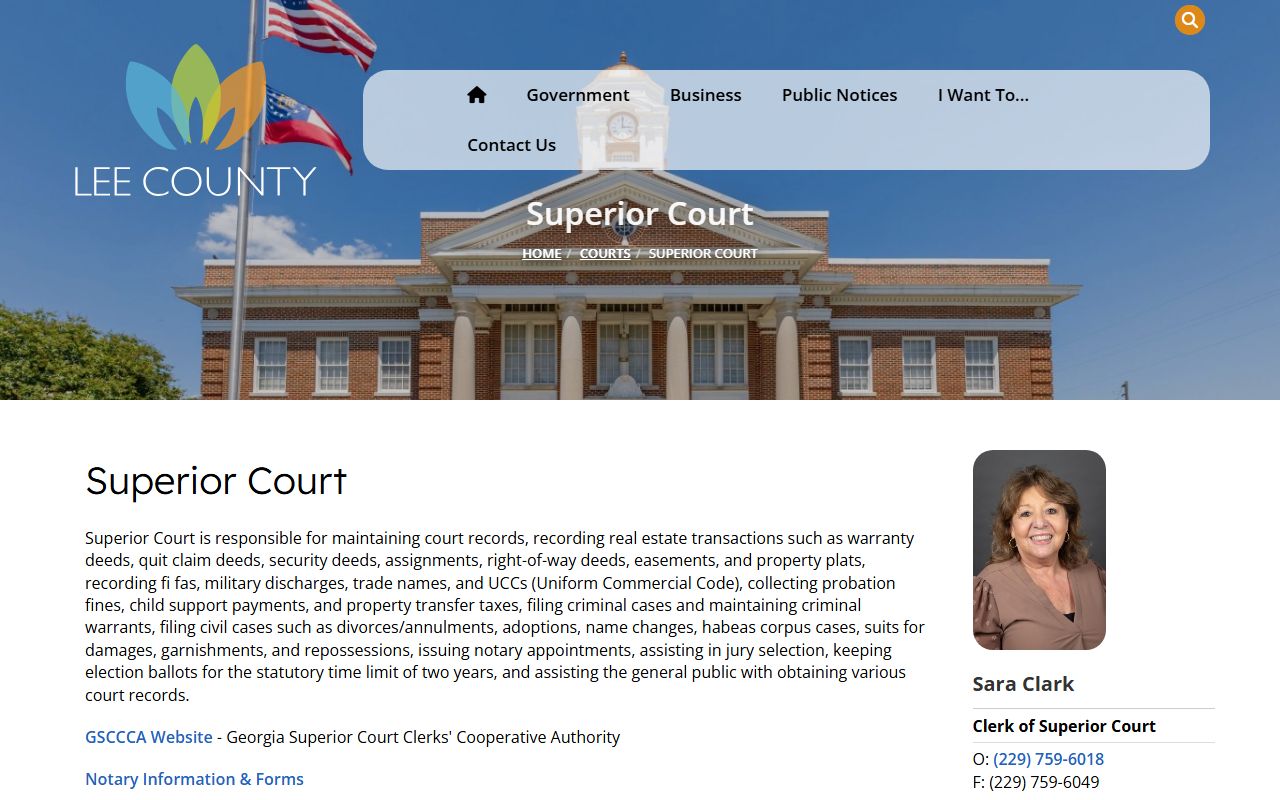
The clerk information shown there is the local record path for Superior Court criminal case files and criminal warrants.
Lee County Arrest Charge Documents
Formal court records after an arrest are built from charging documents and later filings. The research did not locate a Lee-specific public table of document fields, so the safest wording is procedural: a booking charge is the jail-side allegation, while the court charge is the filed or pursued charge in the court case. The District Attorney for Lee County, identified by the Prosecuting Attorneys' Council of Georgia as Lewis Lamb, represents the State of Georgia in felony criminal cases in Superior Court.
| Document | Who Is Involved | What It Does |
|---|---|---|
| Complaint | Law enforcement or prosecutor | Starts or supports an accusation and may be tied to warrant or lower-level proceedings. |
| Information or accusation | Prosecutor | States charges the prosecutor chooses to pursue when allowed by Georgia procedure. |
| Indictment | Grand jury and prosecutor | Formal felony charging document used when a case proceeds through grand-jury action. |
The PAC Georgia Lee County prosecutor page identifies the district attorney contact for the county. Court filings themselves should still be requested from the clerk or the court with the case file.
Lee County Court Charge Status
Charge status language tells whether a court record after a jail arrest is still open, changed, ended, or resolved. A person can be arrested and booked without being convicted. A prosecutor may change a charge after review, a judge may handle bond before a final case exists, and a clerk record may show later events that never appear on the jail roster.
| Status | What It Means |
|---|---|
| Pending | The charge or case remains open. |
| Amended | The prosecutor or court changed the charge. |
| Reduced | The charge changed to a lesser offense. |
| Dismissed | The charge ended without a conviction. |
| Nolle prosequi | The prosecutor declined to proceed on the charge. |
| Convicted | Guilt was entered by plea or verdict. |
| Acquitted | The person was found not guilty. |
Bond Warrants and Court Records
Bond information can appear on a Citizen Connect booking card, but bond hearings and preliminary matters belong with the courts. Lee County Magistrate Court handles bond hearings and preliminary hearings. Judge Jim Thurman's staff page also describes first appearance, extradition, committal, and warrant application hearings. If a listed bond does not result in release, a hold, detainer, probation matter, another county, state transfer, federal issue, or immigration issue may be involved.
| Bond or Hold Term | How It Works |
|---|---|
| Cash bond | Money is deposited to secure release when the court allows it. |
| Surety bond | A licensed bonding company guarantees the bond. |
| Property bond | Property may secure the bond when accepted by the court. |
| Personal recognizance | The court releases the person on a promise to appear and follow conditions. |
| No-bond hold | Release is blocked because no bond is set or another agency hold applies. |
Warrant records are split by function. Lee County Superior Court says it maintains criminal warrants. Magistrate Court says it handles arrest and search warrants and warrant applications. Georgia.gov warrant guidance says users should contact the appropriate county sheriff's office for existing warrants and may need identifying details such as birth date and first and last name.
Search Limits for Lee County Court Records
Georgia Courts eAccess is a directory for court-record access, not a single Lee County criminal search screen. The statewide e-filing page lists Lee Superior Court as PeachCourt mandatory, which means provider accounts are used for electronic filing. Filing access is different from public criminal case lookup. The GSCCCA search page is also limited for this use because the captured categories were real estate, lien, UCC, plat, notary, PT-61, and similar indexes, not a confirmed Lee criminal docket search.
The Lee Magistrate civil public-access portal has login, account, and guest controls, and the county says civil files from 2023 forward require account creation. The captured portal did not expose public criminal or warrant search fields. For older files, restricted files, or non-online criminal records, contact the clerk or court office rather than relying on a statewide index that may not cover the case.
The Georgia Courts eAccess directory may help identify a court access provider, but Lee County research did not confirm a free public criminal docket search.
Charges vs Convictions
A court record after an arrest can show an accusation before any final finding. Public readers often treat a jail charge as a conviction, but that is wrong. Charges may be pending, changed, dismissed, or declined. A conviction requires a plea or verdict. That distinction matters for employment, housing, licensing, immigration, and personal decisions, and it is why court records should be checked before drawing conclusions from a jail roster.
| Charge | Conviction | |
|---|---|---|
| Stage | Allegation or filed count | Final guilt by plea or verdict |
| Record Source | Jail card, warrant, complaint, accusation, or indictment | Court disposition and sentence record |
| Can Change | Yes, it may be amended, reduced, or dismissed | Changes only through later court action |
Restricted Lee County Arrest Records
Georgia's Open Records Act, O.C.G.A. Sections 50-18-70 through 50-18-77, presumes public access but includes exemptions. Pending investigative or prosecution records may be withheld under O.C.G.A. Section 50-18-72, while initial police arrest reports and initial incident reports remain public. Georgia criminal-history dissemination rules also limit how private persons and businesses obtain full criminal-history information without signed consent.
| Restricted or Sealed | Expunged or Record Restricted | |
|---|---|---|
| Public View | Access is limited by law, court order, or record type. | Eligible Georgia arrest history may be restricted for non-criminal-justice purposes. |
| Official Access | Courts and law enforcement may retain access where the law allows. | Criminal-justice agencies may still have access in defined settings. |
| Lee County Path | Ask the court or record-holding agency for the controlling order or exemption. | Use the GBI record restriction process and the prosecutor or arresting-agency path when eligible. |
Important: Court, jail, and criminal-history records are different systems. Verify the final court disposition with the clerk.